For your first round, choose a course you can access, a playing length you can discuss honestly with staff, and a visit you can manage with the equipment, support and time available. A par-3 course, executive layout or nine-hole outing is worth investigating, but none of those labels alone guarantees an easy, quiet or inexpensive round.
This guide helps adult beginners compare US venues before making a booking. It is a selection checklist, not a ranking of courses we have played. Once you have chosen an outing, use the first-round guide for the complete sequence.
Start with the outing, not the course’s reputation
Write down what you need from this visit: your first experience of moving around actual holes, an accompanied introduction, or a shorter outing after lessons. Add your available time, whether you need clubs and how you expect to get around the course.
NCGA’s beginner guidance includes short courses as an alternative to starting on a full-size course. That gives you a useful category to investigate. It does not mean you must complete a particular number of range visits or achieve a certain score before asking a course about playing.
If you have never handled clubs, the first-lesson preparation guide can help you arrange an introduction and discuss a suitable next step. Be clear with the shop about your experience rather than trying to sound more advanced.
Separate hole count, playing length and visit arrangements
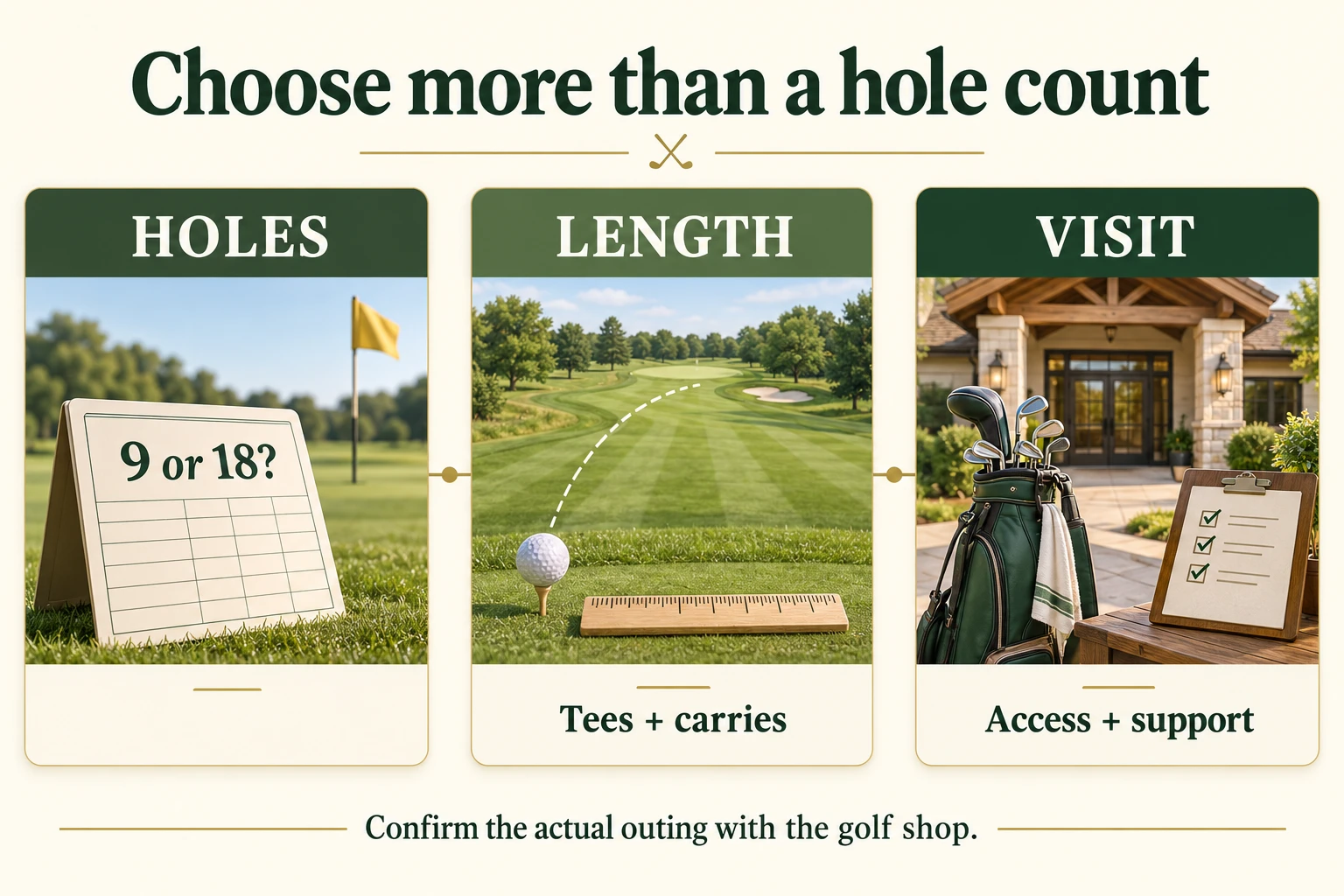
AI-generated conceptual illustration by TeeClear. It shows three separate selection questions, not a real course, a scale drawing or an official recommendation system.
| Option you find | What it tells you | What still needs checking |
|---|---|---|
| Par-3 course | The venue describes a layout of par-3 holes | Individual hole lengths, obstacles, number of holes and access |
| Executive or short course | The venue markets a shorter form of course | Actual hole mix, tee distances and what you are booking |
| Nine-hole course or nine-hole booking | The outing is for nine holes | Whether these are short holes or part of a longer layout, and which nine you will play |
| Eighteen-hole course with shorter tees | The venue offers another playing-distance option | Whether that option suits you, whether a shorter booking is offered, and the visit’s requirements |
These are comparison prompts, not strict categories that never overlap. A par-3 course can also have nine holes. Read the current scorecard and course description rather than selecting on a label alone. Our scorecard guide explains how to locate tee rows and hole information.
Check the holes you would actually play
Ask staff to help you understand the proposed tees and route. Useful questions include:
- What are the shortest and longest holes from those tees?
- Are there places where the ball must carry over water, a ravine or another obstacle to reach the intended landing area?
- Are there steep walks, long transfers between holes or other features relevant to getting around?
- Can staff suggest a suitable starting option if you do not yet know your reliable hitting distances?
The purpose is to compare a real layout with your current experience. We are not assigning a universal yardage limit or choosing tees by gender, color or your companions’ preferences. If you do know a repeatable distance, explain how you obtained it; if you do not, say so rather than guessing a number.
A short layout is not necessarily obstacle-free. For example, Campus Commons’ own course description identifies a nine-hole par-3 course and also describes trees and water features. Its published description illustrates why the holes matter alongside the count. It is not evidence of how you personally would score there.
Check that the venue supports your kind of first visit
Confirm the exact course and address, especially at a complex with several layouts or practice areas. The City of Bellevue, for example, lists Bellevue Golf Course and Crossroads Par-3 as separate options. A booking link or range address associated with the same operator may not identify the outing you intended.
Then check how newcomers are admitted, whether help or an accompanied session is available, and how equipment is arranged. Campus Commons’ FAQ describes beginner clinics and adult and junior rental clubs. Crossroads’ operator page describes a nine-hole par-3 course and complimentary clubs. Neither confirms the handedness, length or availability of suitable equipment for your particular visit. Follow the rental-club checklist if you will depend on supplied clubs.
Ask about walking, carrying, push carts and riding according to your needs. Do not infer a riding cart from a course photograph. Campus Commons’ course page says “Walking Only,” while its FAQ describes limited carts with separate arrangements. Anyone relying on a cart should resolve that difference with the shop before choosing the visit.
Confirm the date and the actual start procedure
Do not assume every public course requires a tee time—or that a walk-in policy guarantees a start. Crossroads’ description says regular play is first-come, first-served, but the page also contains booking prompts. Its operator’s seasonal-hours block and the city’s season listing differ. Ask the shop to confirm the current procedure and opening date before traveling.
For a contrasting operator policy, JC Golf’s general FAQ recommends reservations and makes walk-ins conditional on availability. It also says cart inclusion varies. These examples support checking the exact outing rather than applying another course’s policy.
Ask which session staff suggest for a new player, how much time to allow for the whole visit and what happens if play is delayed. Early morning, weekday or twilight is not an automatic promise of quiet conditions. If daylight is limited, establish what you are purchasing and whether completion is guaranteed; do not build your plan around an assumed round duration. Use the pace-of-play guide for preparation once an appropriate visit is arranged.
Compare two real options before paying
Use this editorial worksheet with actual answers. You do not need to award points or select the course with the lowest headline fee.
| Record for each option | Your answer |
|---|---|
| Exact course, route, holes and proposed tees | ___ |
| Beginner access and any experience requirement | ___ |
| Playing length and obstacles discussed with staff | ___ |
| Available help, clinics or accompanying-player arrangements | ___ |
| Suitable clubs and transport confirmed | ___ |
| Start procedure, opening date and time to allow | ___ |
| Complete charge, clothing and cancellation/weather conditions | ___ |
Use the first-round budget to separate required charges, included items and unresolved costs. A cheaper green fee does not settle the total if a second option includes something you would otherwise need to pay for.
Our suggested message is: “I am arranging my first round after [describe practice or lessons]. I need [clubs or other support] and have [time available]. Which course, tees and session would you suggest, and what must I confirm before booking?”
Choose the option whose important questions you can resolve. If a necessary club option, access condition or transport arrangement remains unknown, contact the shop or compare another venue. Then use the booking questions and the preparation checklist to turn the choice into an organized visit.
Sources and scope
Research checked 17 October 2026 using the relevant written NCGA, Campus Commons, Crossroads, City of Bellevue and JC Golf sections linked above. Facility examples are evidence of specific published descriptions and policy differences, not local recommendations or confirmation of current availability. The comparison table, questions and message are TeeClear’s editorial suggestions. No course visit, booking, performance test or firsthand accessibility assessment was performed.
Cover photo: Lucie Liz on Pexels, used under the Pexels License. Illustrative stock photography; it does not depict a verified example venue from this guide or imply an endorsement.