For a straightforward first golf-ball purchase, choose a clearly identified pack or lot whose condition, quantity and complete cost you understand. New balls and clearly described used balls are options to compare. Refinished balls have undergone additional surface processing and should not be treated as factory-new simply because they look clean. We do not have test results establishing one model as best for every beginner.
Before ordering, check what you already have and what your booked rental supplies. If suitable balls are already arranged, a separate purchase may be unnecessary. Use the first-round packing list for departure preparation; this page focuses on buying the balls themselves.
Choose the purchase before chasing a performance label
Our suggested starting point is a manageable quantity within your complete equipment budget, with the model and condition clearly stated. Do not buy a large mixed bucket solely to obtain a lower headline price per ball if you cannot establish what is inside.
Read the manufacturer’s description for the exact model. For example, Titleist’s TruFeel product page shows a per-dozen price alongside selectable options and separate purchase/subscription controls. Save the actual model, selected variant, quantity and purchase type. The example explains a listing check; it is not a tested recommendation for TruFeel or a current quote for your basket.
Terms such as soft, distance or tour do not establish your personal result. Titleist’s compression explanation identifies compression as one design element alongside construction characteristics such as materials, layers and dimples. We therefore do not assign a ball to a beginner using a universal compression number or an assumed swing speed. Ask an instructor or fitting provider if you need a player-specific comparison.
New, recycled and refinished are different descriptions
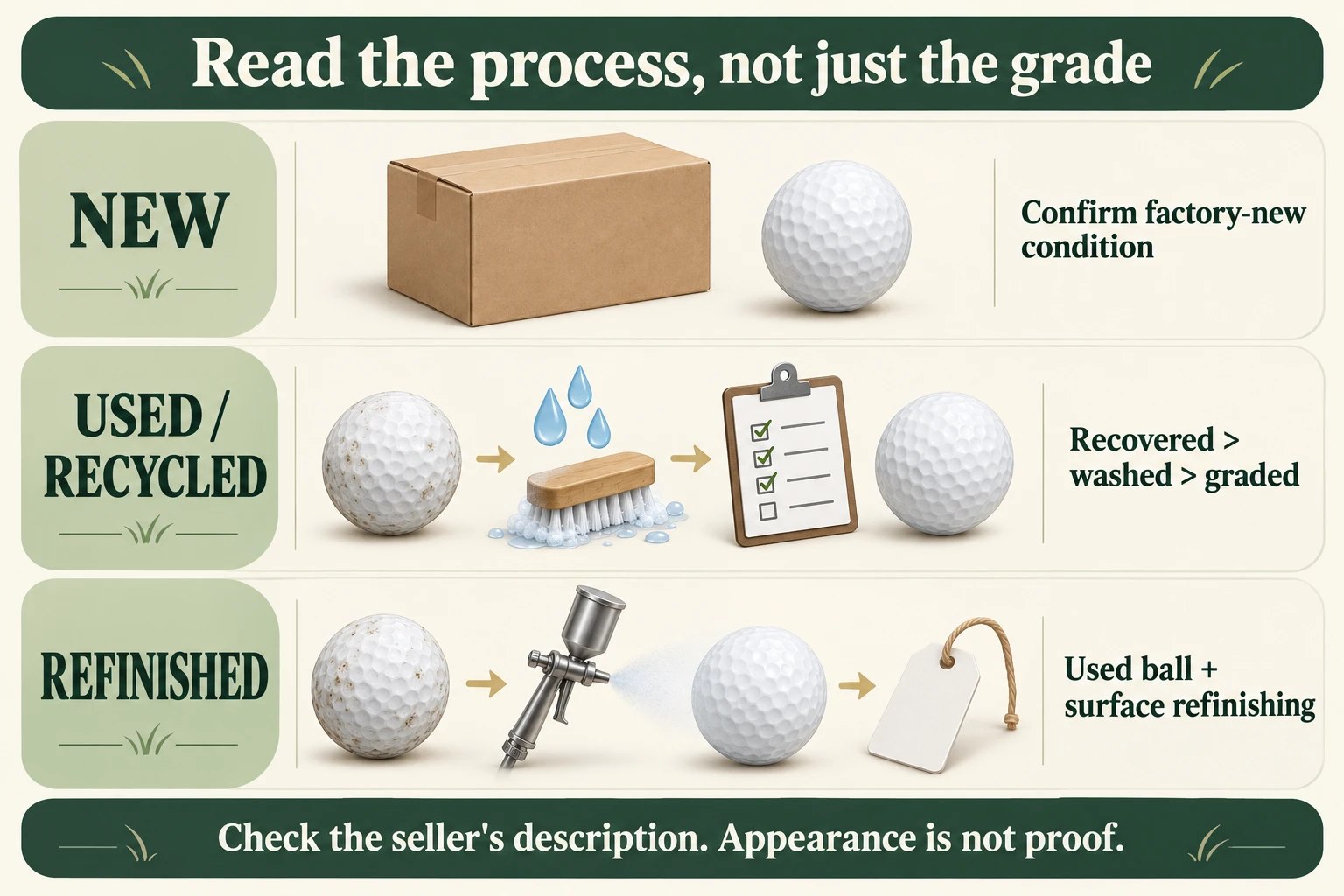
AI-generated conceptual illustration by TeeClear. These are simplified seller-described routes, not photographs of inspected balls or instructions for processing them. A clean appearance does not prove factory-new condition.
| Listing description | Establish before buying |
|---|---|
| New | Is it explicitly factory-new stock, in what packaging, and for which exact model and version? |
| Used or recycled | Has it been cleaned and graded? Is the original finish retained? What wear, markings or substitutions does the seller allow? |
| Refinished or refurbished | What processing has been performed, who performed it and how is the product identified? |
| Mixed, assorted or practice lot | Which models and versions may be supplied, in what condition, and are any contents excluded from the promise? |
LostGolfBalls describes cleaning and sorting its recycled balls separately from refinishing steps that can include stripping, painting, stamping or clear coating. GolfBallNut’s written guide similarly distinguishes original-finish recycled balls from restored, refinished balls. These descriptions support keeping process and condition separate; they do not verify the history of an individual ball you receive.
Ask what refurbished means in the actual listing rather than assuming every seller uses the word identically. A refinished ball can have a new-looking surface while remaining a previously used ball. Neither a seller’s appearance claim nor our illustration establishes distance, spin, durability or equivalence to a new ball.
Read the seller’s grade definition
Grade names are not a universal conversion table. LostGolfBalls uses names including Mint (5A), Near Mint (4A) and Good (3A). GlobalGolf’s used-ball ratings use Mint, AAA, AA and Practice. Read each seller’s written definition; do not match the letters across those systems and assume equivalent contents.
Check whether the selected grade permits player ink, company logos, discoloration, scratches, practice models or x-outs. For example, LostGolfBalls’ Good (3A) description allows some practice models and x-outs. A grade that permits those items is a different purchase from a listing that explicitly excludes them.
Words such as pristine or mint should prompt a condition check, not replace one. Record whether the listing says the balls are new, previously used in their original finish, or refinished. If you want a consistent model, ask whether the lot can mix generations or related models under one family name.
Seller statements that a grade plays like new are not TeeClear test results. We have not independently measured the condition or performance of these suppliers’ stock.
Compare quantity and the complete cash outlay
Use the actual ball count rather than package size or a photograph. A dozen is twelve balls, but a listing may sell several dozen, a larger bucket or an assorted count. Confirm the selected quantity and any minimum order before comparing prices.
Use this editorial worksheet:
| Record | What belongs in the comparison |
|---|---|
| Identity | Brand, exact model, version if known, color and any permitted mixture |
| Condition and process | New, original-finish used, refinished or another clearly explained description |
| Quantity | Actual number of balls in the selected purchase |
| Delivered total in USD | Ball price, shipping, taxes and any required charges after applicable discounts |
| Price per ball | Delivered total divided by the confirmed ball count |
| Complete commitment | Whether this is a one-time order or a recurring purchase |
A lower price per ball can still require more money upfront. Compare both figures, and do not spend more merely to cross a free-shipping threshold. Keep the purchase inside your first-equipment budget; the first-round budget tool can record what this outing will actually require.
How many should you buy or carry? We have no first-round loss-rate data supporting one universal quantity. Consider the planned outing, what you already own, confirmed rental inclusions and whether you can obtain more at the venue. Ask your instructor or shop for a starting amount appropriate to that visit, rather than treating an arbitrary bulk purchase as essential.
Inspect the delivery before playing
Count the balls, check the actual model and finish description, and compare visible wear and markings with the purchased grade. Photograph discrepancies and keep the packaging and order confirmation. If a ball appears cut, cracked or otherwise questionable, set it aside and ask the seller about the discrepancy before using it. A visual check cannot certify internal condition or prior storage history.
Read the detailed return terms before an on-course trial. As checked on 17 October 2026, LostGolfBalls’ return page requires notice within 30 calendar days of receipt, says returned products must be unused and in the condition received, and assigns return shipping to the buyer except for damaged or incorrect items. Its grading page also repeats a generic “Free Returns” message. Ask which terms apply to the actual order rather than assuming free returns after play. Another seller may have different conditions.
If your outing is an organized event, ask the organizer about its equipment requirements; this buying guide does not decide ball eligibility for competitions. It also does not turn a practice-facility ball into a permitted takeaway purchase.
Personalize after choosing the base ball
Choose the model, condition and quantity first. Then use the personalized golf-ball ordering guide if you want optional text or artwork; it covers order types, proofs, minimums and provider-specific terms. Do not commit to a larger print order simply because a supplier’s standard personalization route has a minimum quantity.
Return to the first-clubs and equipment checklist for the wider budget, or finish packing for the round once the balls are arranged.
Sources and scope
Research checked 17 October 2026 against the relevant written Titleist product/compression, LostGolfBalls grading/returns, GolfBallNut process and GlobalGolf condition sections linked above. Manufacturer descriptions and seller grades are attributed information, not independent testing. Exact delivered prices, selected stock, production-year identity and individual-ball history are not confirmed here. No balls were purchased, inspected in person or tested by TeeClear; the worksheets and purchase sequence are editorial suggestions.
Cover photo: Kindel Media on Pexels, used under the Pexels License. Illustrative stock photography; the pictured balls are not grade samples, a recommended quantity or a TeeClear purchase.