Which golf tees should beginners use?
Choose beginner golf tees using the actual scorecard, manageable carries and staff advice, even without a known hitting distance or handicap.
Last updated
For your first casual round, ask the golf shop to help you choose a shorter tee set with manageable shots and carries. Use that course’s actual scorecard and your current ability; a color, your gender or your playing partner’s choice is not enough to select beginner golf tees.
You do not need to invent a handicap or guess a driving distance to ask for help. This guide offers preparation questions, not a fitting algorithm or a ruling about competition eligibility.
Start with the course, then choose its tee set
If you have not selected a venue, first use the first-round course checklist. A shorter tee set changes the length of a particular layout; it does not establish that every hole, crossing or walking route suits your visit.
The NCGA’s first-round advice encourages beginners to consider shorter facilities and select appropriate tees rather than simply following experienced partners. The PGA’s course-setup guide, especially its tee-naming and cross-hazard sections, supports matching tee choices to ability and distance rather than gender labels. It also explains why a crossing obstacle can matter independently of total length.
Our practical starting point: ask which available forward or shorter option the staff recommends for a first visit, then check the holes that could still present a problem.
Read the row, not just the color
These are two California course examples checked on 17 October 2026, not recommendations to book either venue:
| Exact course | Orange tees, 18 holes | Green tees, 18 holes |
|---|---|---|
| Poppy Hills | 5,224 yards, adding the published front and back totals | 4,173 yards, adding the published front and back totals |
| Poppy Ridge, 18-hole course | 7,010 yards | 4,225 yards |
The same Orange label represents very different lengths. Poppy Ridge also publishes a separate Ridge 9 scorecard: make sure you are reading the layout you actually booked. Both examples are NCGA-owned courses; they illustrate their own published configurations, not independent testing of a tee-selection method.
Before the round, identify the tee name or color, the row for your booked holes, and the total yardage. Use the scorecard guide if the rows are unfamiliar. Confirm the day’s markers with staff; a published card is not a live measurement of every marker position.
Check carries as well as total yardage
A carry is the distance the ball travels through the air before landing. A forced carry means an obstacle must be crossed through the air to reach the intended landing area. Roll after landing cannot help a ball cross water that comes first.
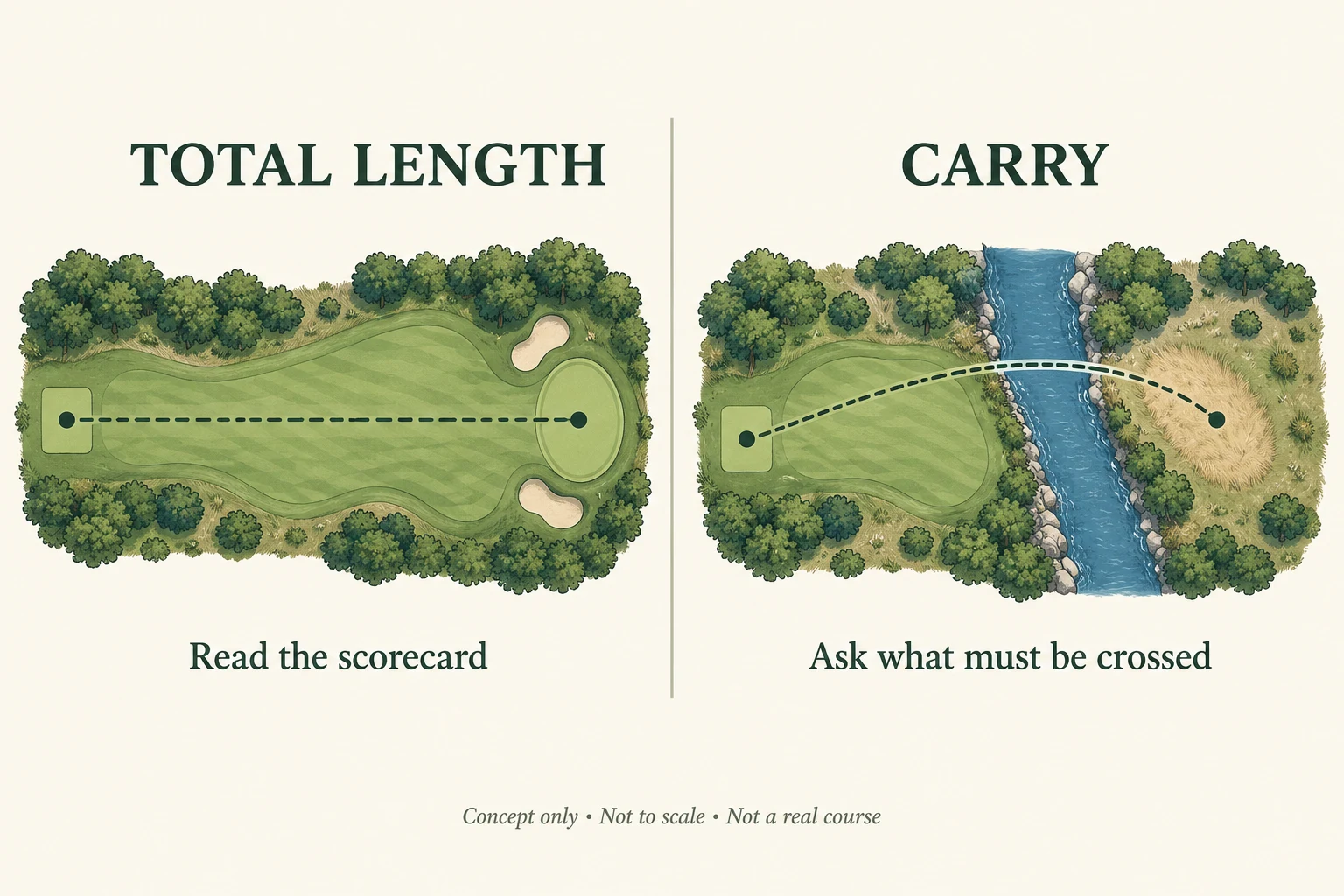
TeeClear concept illustration, generated for this guide. Not to scale, not a real course and not a rules or relief diagram.
Use these questions when discussing a tee set with staff:
- Are there tee shots across water, a ravine or another area that a short shot cannot clear?
- Is there a practical route around that crossing from the proposed tees?
- Which holes are the most demanding from that option?
- Does the course offer a shorter layout or a beginner session if those shots are unsuitable?
These are selection questions, not permission to move a ball or create your own starting point. If a proposed arrangement changes normal play, ask the course or organiser what is permitted and how the session is being treated.
If you do not know your distances
Tell the shop plainly: “This is my first round. I do not have reliable distance numbers. Which tees or shorter layout would you suggest, and are there unavoidable carries?”
If you have practiced, describe the club you used and what you actually observed, including whether the number was carry or total distance. Do not substitute your single longest shot for a normal result. If you have no dependable observations, leave that field unknown. A first lesson can also be a place to discuss readiness and suitable on-course options.
We have not reproduced a universal distance chart here. The current USGA method pages were inaccessible during this check, and an older course-design chart is not a substitute for verifying that method and its assumptions.
Agree on the choice before starting
Ask staff about different tee choices within your group and any event restrictions before heading out. Tell your partners which set you plan to use, locate its first markers, and be ready at the instructed starting time. A first visit is a reason to ask questions, not a reason to match someone else’s longest setup.
Next, confirm your booking and arrival arrangements. If the recommended options still feel unsuitable, return to venue selection rather than forcing the original booking to work.
Sources and scope
The linked NCGA advice, PGA course-setup guide and two official course scorecards were read on 17 October 2026. The PGA guide is a historical facility-design resource; its old handicap procedures and numerical charts are not used here. Tee choice, booking policies and competition requirements should be confirmed for your actual visit. Prepared by TeeClear from published sources; no visit, coaching qualification or measured-distance test is claimed.