How does relief work in a general-area cart-path example?
Work through a general-area cart-path example: interference, nearest point of complete relief and the correct relief area.
Last updated
Scope: Fictional teaching scenarios for individual stroke play under the 2023 Rules. Relevant rule text and written clarifications were rechecked on 17 October 2026, with the supplement dated 2 October 2026 screened for relevance to this example. Local Rules and the actual facts still need checking; this is not an adjudication of your round.
Scenario and assumptions
Original example: a right-handed player’s ball rests on an artificially surfaced path in the general area. The path is an immovable obstruction, not a boundary or integral object. A normal stroke is otherwise reasonable; there is no penalty area, no-play zone or special Local Rule affecting this example.
Short answer for this scenario
Rule 16.1a–b can allow free relief when the condition interferes with the ball, intended stance or intended swing. In the general area, the reference point is the nearest point of complete relief. The relief area is one club-length from that point, in the general area, not nearer the hole, and must provide complete relief from the condition.
The nearest point is not whichever side offers the best lie. The USGA’s nearest-point explanation reinforces that it relates to the stroke that would have been made without the interference.
Work through the example
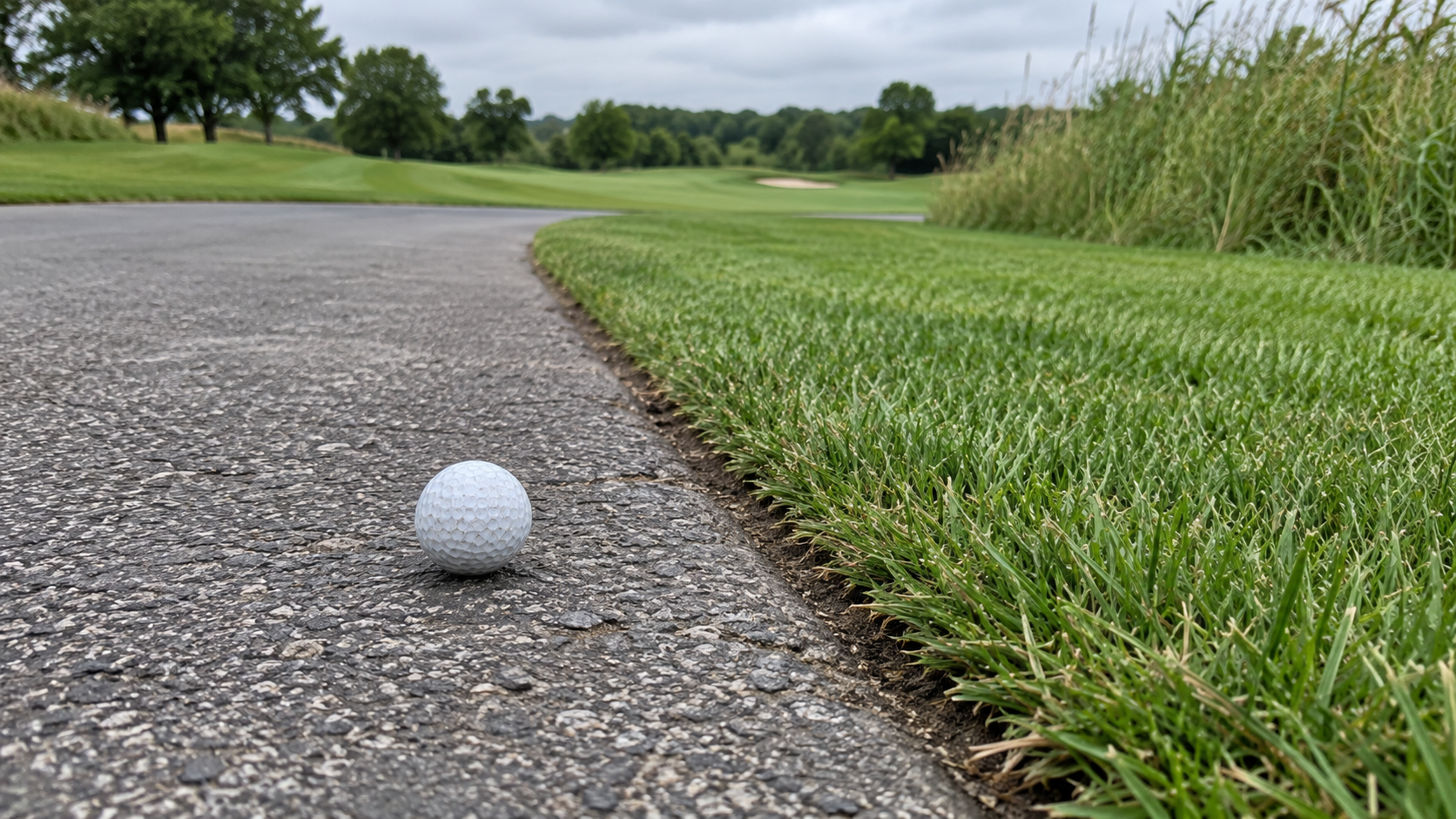
AI-generated fictional teaching scene; not an actual photograph or playing record. Fictional starting position: a ball on a surfaced cart path. No relief point or dropping area is shown.
- Describe the original ball position and intended stroke before lifting anything.
- Confirm that the path and interference qualify under the stated assumptions.
- Estimate the nearest point providing complete relief for that intended stroke.
- Establish the relief area and use the Rule 14.3 dropping procedure.
- Confirm the ball was dropped in and came to rest in the relief area, with complete relief for the intended stroke, before playing.
A properly dropped ball in a bad lie within the permitted relief area does not earn another free drop just because the lie is unattractive. Clarification 14.3c/1 includes bushes and growing things in that area. Inspect the nearest point and available area before lifting; relief is from interference, not a promise of short grass.
These are conceptual stages. The accompanying image shows only the initial ball position, not a relief point or dropping area. A left-handed stance or a different reasonable intended stroke may change the reference point; do not transfer a reference point from a different example.
Two errors to avoid
An imaginary player sees short grass on the far side and chooses it because the shot is easier. That does not establish the nearest point. Another drops the ball off the path but still needs to stand on it for the intended stroke. That raises the complete-relief condition; moving the ball off the surface alone is not enough.
What changes the answer
A path affecting only the line of play in the general area does not automatically create relief under this Rule. A clearly unreasonable stroke, an integral object, a ball in a penalty area or a different course area needs a different analysis. Do not transfer this example to a boundary fence or bunker.
Compare unplayable-ball options and wrong-place mistakes. For live questions use official resources.
Sources and scope
Relevant rules and clarifications rechecked 17 October 2026. Initial research: 15 October 2026. Initially published following user confirmation on 16 October 2026; maintained on 17 October at the user’s request; independent professional rules review is not claimed. The examples do not establish a particular course’s Local Rules.