How should I compare unplayable-ball options?
Distinguish general-area, bunker and penalty-area cases before comparing unplayable-ball relief options.
Last updated
Scope: Fictional teaching scenarios for individual stroke play under the 2023 Rules. Relevant rule text and written clarifications were rechecked on 17 October 2026, with the supplement dated 2 October 2026 screened for relevance to this example. Local Rules and the actual facts still need checking; this is not an adjudication of your round.
Scenario and assumptions
Original example: a player finds and identifies their ball under a bush in the general area during individual stroke play. They know its spot but do not want to attempt the stroke. No abnormal-condition relief or special Local Rule is assumed.
Short answer for this scenario
The player decides whether to take unplayable-ball relief. Rule 19.2 provides stroke-and-distance, back-on-the-line and lateral options, each for one penalty stroke in the general-area example. Knowing the original spot is necessary for the latter two options. Relief does not guarantee that the new position will be pleasant or playable.
Evaluate the options before moving the ball
| Option in this example | Starting information |
|---|---|
| Stroke and distance | Where the previous stroke was made; apply Rule 14.6 |
| Back on the line | Hole and original ball spot; check the full current dropping construction |
| Lateral | Original ball spot; two-club-length area with the Rule’s location limits |
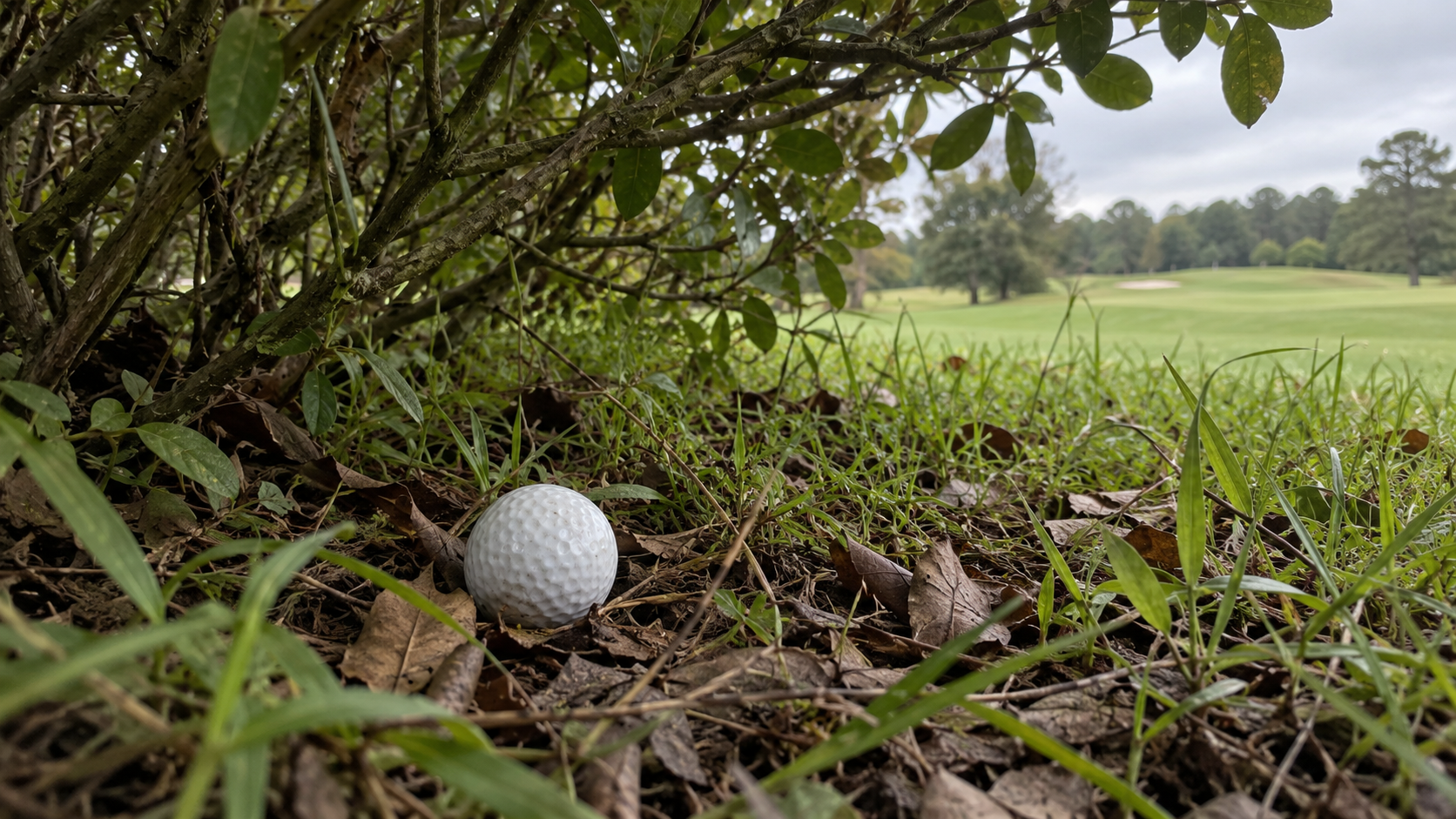
AI-generated fictional teaching scene; not an actual photograph or playing record. Fictional ball position beneath a bush. The player decides whether to take unplayable-ball relief under the applicable Rules.
Suppose the imaginary bush is wider than the lateral distance. The worksheet does not promise that the lateral option reaches open ground. Consider the actual permitted area before choosing; do not extend the distance because the first location remains awkward.
Back-on-the-line and a second difficult lie
For this known-spot example, keep the original ball spot between the hole and the dropping spot on the line. The ball must first touch the ground on that line; its landing point creates a one-club-length relief area, subject to Rule 19.2b’s limits. A drop beside the line that rolls onto it does not meet this requirement; see Clarification 14.3b(4)/1.
If a correctly dropped ball stays in its relief area but is still unplayable, there is a new situation. Choosing unplayable relief again carries an additional penalty; a bad lie alone is not a free re-drop. Clarification 19.2/1 explains this limit.
The course area matters
Rule 19 unplayable relief is unavailable in a penalty area; investigate Rule 17 instead. A bunker has separate conditions: normal lateral and back-on-the-line relief must remain in the bunker, while an additional back-on-the-line option outside it carries two penalty strokes. Stroke-and-distance depends on where the previous stroke was made. Do not describe every exit from a bunker as a two-stroke option.
The USGA bunker lesson and the current R&A text support that distinction. A case involving temporary water in a bunker is a different question from simply deciding a ball is unplayable.
What this example does not cover
It does not cover a ball high in a tree, an unknown ball position, mobility-device modifications, dangerous animals or a sequence of failed drops. These are review variants, not reasons to extend the simplified table without checking the text.
Compare penalty-area options and the cart-path example. Gather real facts using the public worksheet.
Sources and scope
Relevant rules and clarifications rechecked 17 October 2026. Initial research: 15 October 2026. Initially published following user confirmation on 16 October 2026; maintained on 17 October at the user’s request; independent professional rules review is not claimed. The examples do not establish a particular course’s Local Rules.