Why do wrong ball and wrong place require different checks?
Understand ball identity versus playing location, with different correction questions for wrong ball and wrong place in stroke play.
Last updated
Scope: Fictional teaching scenarios for individual stroke play under the 2023 Rules. Relevant rule text and written clarifications were rechecked on 17 October 2026, with the supplement dated 2 October 2026 screened for relevance to this example. Local Rules and the actual facts still need checking; this is not an adjudication of your round.
Two original teaching scenarios
Assume individual stroke play with no special Local Rule changing the relevant procedures.
Scenario A: Morgan finds a ball with the same brand and number as theirs, plays it, and then sees a different identifying mark. It belongs to someone else and is not Morgan’s ball in play.
Scenario B: Riley takes relief using the correct ball in play but plays it from a location outside the permitted relief area.
These are invented teaching examples, not incidents observed or adjudicated by TeeClear.
Short answer for these scenarios
Scenario A raises wrong ball under Rule 6.3c. In stroke play, the general penalty applies and the mistake must be corrected using the right ball under the Rules; wrong-ball strokes do not form the hole score. Scenario B raises wrong place under Rule 14.7. The general penalty applies, but whether correction is required depends on whether there was a serious breach. The correction questions are therefore different.
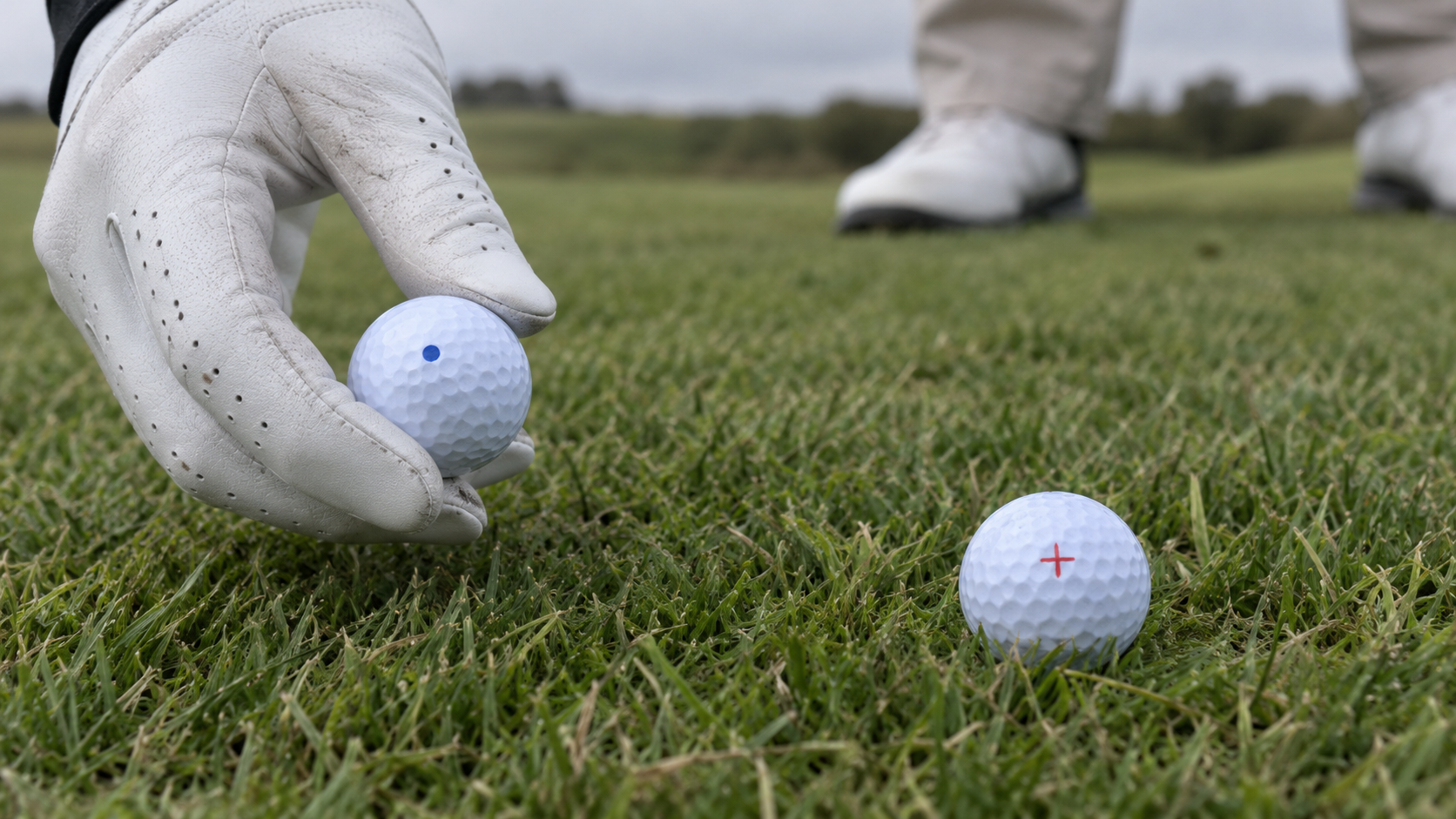
AI-generated fictional teaching scene; not an actual photograph or playing record. Ball-identification illustration only. It does not show wrong-place relief or permission to lift a ball without following the applicable procedure.
Why “add two and carry on” is incomplete
For a wrong ball in stroke play, correction is required. For wrong place, a non-serious breach is normally completed with that ball; a serious breach requires correction. Starting the next hole or returning the final scorecard can close a correction opportunity under the relevant provisions. A referee or Committee should resolve uncertainty about the facts and seriousness before those stages are reached.
For these stroke-play cases, the deadline is before making a stroke to start another hole, or, on the final hole, before returning the scorecard. Under Rule 14.7b, if unsure whether a wrong-place breach is serious, complete the hole with both the original wrong-place ball and a second ball played from the right place under the Rules. Report the facts to the Committee before returning the scorecard, even if both balls score the same or you decide not to finish both; failing to report means disqualification. A non-serious wrong-place breach does not require that correction.
This guide does not calculate combined penalties for multiple related acts. It also does not apply the stroke-play examples to match play, which has different provisions.
Ball identity is more than the printed brand
Marking a ball helps recognition, but “another ball” is not automatically a wrong ball in the Rules sense. Substituting a ball, whether permitted or not, can make it the ball in play and introduce a different issue under Rule 6.3b. That distinction is why the FSGA comparison is used as a cross-check rather than relying on everyday phrasing alone.
If Riley notices a dropping mistake before playing, Rule 14.5 may be relevant. Do not apply the after-stroke correction discussion before establishing whether a stroke was made.
Return to the rules starting point or use the public official-resource guide. Prevention starts with checking your ball and procedure, not guessing a penalty afterward.
Sources and scope
Relevant rules and clarifications rechecked 17 October 2026. Initial research: 15 October 2026. Initially published following user confirmation on 16 October 2026; maintained on 17 October at the user’s request; independent professional rules review is not claimed. The examples do not establish a particular course’s Local Rules.