What changes between a lost ball and out of bounds?
Learn how lost-ball timing differs from out-of-bounds position, plus stroke-and-distance basics and the limits of Local Rule E-5.
Last updated
Scope: Fictional teaching scenarios for individual stroke play under the 2023 Rules. Relevant rule text and written clarifications were rechecked on 17 October 2026, with the supplement dated 2 October 2026 screened for relevance to this example. Local Rules and the actual facts still need checking; this is not an adjudication of your round.
Scenario and assumptions
In this original teaching scenario, a player hits from the tee in individual stroke play. The ball may be in rough beside a boundary. It is not known or virtually certain to be in a penalty area or another condition giving a different remedy. No applicable Local Rule has yet been confirmed.
Short answer for this scenario
A ball is lost when not found within three minutes after the player or caddie begins searching, subject to the identification provisions of Rule 18.2a. Out of bounds concerns the whole ball being beyond the boundary edge, not whether it was found. Under the normal Rule 18.2b procedure, either result requires stroke and distance: one penalty stroke and another stroke from the previous place using Rule 14.6.
If the initial tee stroke is the only stroke made, adding one penalty stroke means the replayed tee stroke is the third stroke. This is illustrative arithmetic, not a record of an actual TeeClear round.
Found in time is different from identified in time
If a possible ball is found within the three-minute search period, Rule 18.2a(1) allows reasonable time to identify it, even if that extends beyond three minutes, including reasonable time to reach it. Identify it promptly. This is not permission to keep searching beyond three minutes for a ball that has not been found. Rule 18 and its search clarifications distinguish these situations.
Work through the distinction
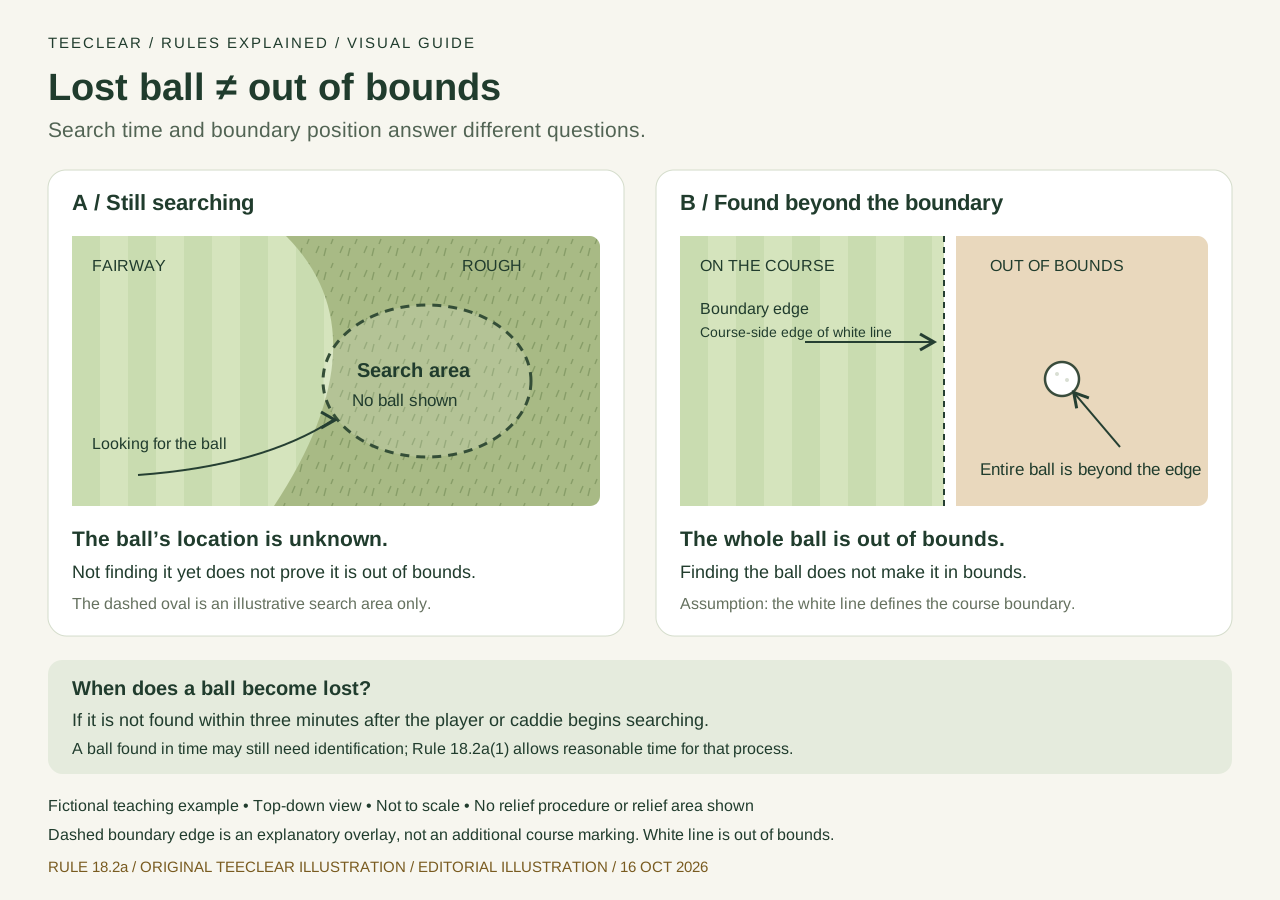
Original fictional teaching illustration, not to scale. The dashed boundary edge is an explanatory overlay. This image shows ball status, not a relief procedure.
First establish the facts. Finding the ball beyond the boundary does not make it playable from that location. Conversely, failing to find a ball near a boundary does not prove that it crossed the boundary.
If the ball might be lost outside a penalty area or might be out of bounds, Rule 18.3 allows a provisional subject to its conditions. The player must make the required announcement before the stroke. Do not treat simply hitting “another one” as a complete provisional procedure. When the provisional becomes the ball in play or must be abandoned needs a separate fact check.
What can change the answer
Model Local Rule E-5 can supply a different, two-penalty-stroke relief option only if adopted and applicable. It has a defined relief area and restrictions, including treatment of a provisional. It is not a universal permission to drop where you think the ball disappeared. This guide deliberately does not reduce that relief-area construction to a shortcut.
Known or virtually certain penalty-area cases lead to a different investigation. See red and yellow penalty-area options. A difficult ball that has been found in bounds is not automatically a lost ball: compare unplayable-ball options.
For gathering the facts, use the public situation worksheet.
Sources and scope
Relevant rules and clarifications rechecked 17 October 2026. Initial research: 15 October 2026. Initially published following user confirmation on 16 October 2026; maintained on 17 October at the user’s request; independent professional rules review is not claimed. The examples do not establish a particular course’s Local Rules.